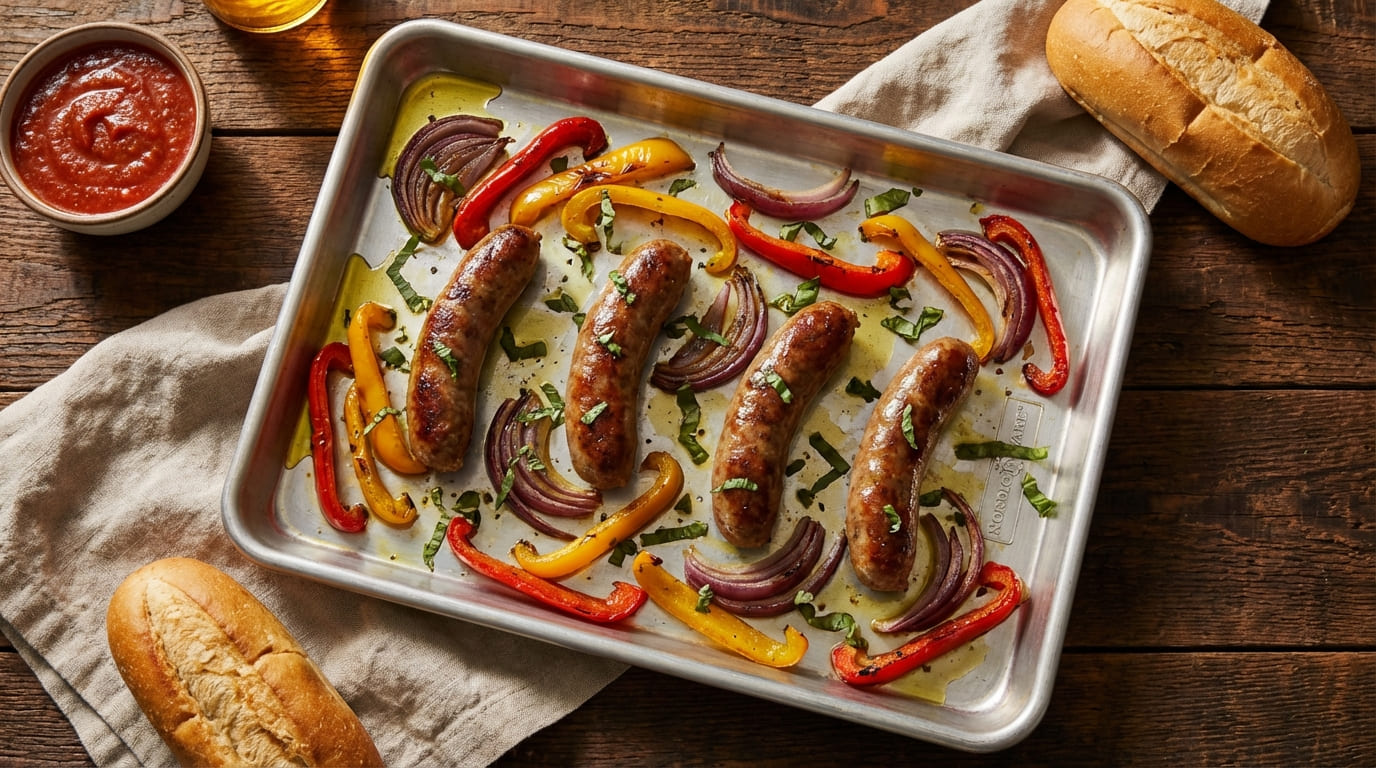
If you grew up in a household where Italian-American cooking was part of the rhythm of life, you already know the smell of sausage and peppers. It’s a smell that belongs at summer street fairs, Sunday family dinners, backyard barbecues, and — once you make this recipe — at your own kitchen table on a Wednesday evening without any of the traditional fuss. This sheet pan sausage and peppers brings one of the great Italian-American classics into modern weeknight territory: 10 minutes of prep, one pan, and 35 minutes in the oven while you do something else entirely.
The concept sounds simple because it is. But there’s meaningful technique embedded in the simplicity. The oven does something to Italian sausage and bell peppers that a stovetop skillet simply cannot replicate at scale. At 220°C (425°F), the fat in the sausage slowly renders outward from the casing, basting the sausage from the inside as it roasts. That rendered fat then drips down and mingles with the olive oil and seasoning on the peppers and onions below, creating a natural pan sauce that flavors every vegetable on the sheet. The peppers soften and caramelize at their edges. The onions turn sweet and jammy. The sausage develops a slightly blistered, golden-brown exterior that no stovetop sear can match without splitting the casings and losing all those juices.
This is the one pan meal concept at its purest and most satisfying: everything goes on together, everything finishes together, and the act of cooking in the same space allows the flavors to interact and deepen in ways that separate cooking methods simply don’t permit. The peppers taste like they’ve been kissed by sausage fat. The sausage carries the faint sweetness of caramelized onion. The whole pan smells like an Italian kitchen in the best possible way.
“Sheet pan cooking isn’t a compromise with flavor — it’s a collaboration between ingredients. Everything on that pan influences everything else. That’s the secret.”
Bell pepper selection matters more than most recipes acknowledge. Red and yellow bell peppers are significantly sweeter than green — they’ve been left on the plant longer to fully ripen, which converts their starches to natural sugars. When those sugars hit high oven heat, they caramelize into a soft, intensely sweet version of themselves that provides a counterpoint to the savory, fennel-spiced richness of the Italian sausage. Green bell peppers work, but they contribute bitterness rather than sweetness — which creates a different, less balanced flavor profile. For this recipe, red and yellow are the correct choice.
Sausage variety also opens up significant flexibility. Sweet Italian sausage is the classic — its fennel seed seasoning and mild sweetness is the foundational flavor profile this dish is built around. Hot Italian sausage works equally well if you want heat. Chicken or turkey Italian sausage delivers a leaner result with a slightly lighter texture. All three follow the exact same method and cook time — the recipe doesn’t change, only the flavor character does.
The versatility of the final dish is another reason this easy dinner deserves a permanent spot in your rotation. Straight from the pan, it’s a complete protein-and-vegetable meal. Stuffed into hoagie rolls with a spoonful of marinara and melted provolone, it becomes the best sausage sub you’ve ever had at home. Sliced and tossed with pasta and the pan drippings, it’s a full Italian pasta dinner with zero extra work. Over white rice or polenta, it’s comfort food at its most straightforward. One recipe, four entirely different meals — that’s genuine weeknight value.
For more sheet pan dinners that follow this same hands-off, big-flavor philosophy, the full Sheet Pan Dinners collection has everything from chicken thighs to salmon to vegetables — all optimized for the same high-heat, one-pan approach. And if Italian flavors are your comfort food language, the Italian recipes collection has a growing library of restaurant-quality Italian dinners that all come together with weeknight efficiency.
One final note: the Nordic Ware Baker’s Half Sheet Pan is referenced throughout this recipe for a specific reason. It’s a heavy-gauge aluminum pan that doesn’t warp at 425°F — a critical quality at this roasting temperature. Thin, cheap sheet pans warp and buckle in a hot oven, causing uneven cooking and pooling of the rendered sausage fat in one spot rather than distributing it evenly across the vegetables. A quality sheet pan is a one-time investment that pays dividends on every roasted dinner you ever make. This is the one we trust for every recipe in the sheet pan category.
Chef’s Note: Don’t Crowd the Pan — This is the Only Rule That Matters
Every recipe in the sheet pan category lives or dies by one principle: single layer, no overcrowding. When ingredients overlap or are packed too tightly, the oven’s heat cannot circulate between them. Steam builds up and the vegetables stew in their own moisture rather than roasting — which means soft, waterlogged peppers and pale, steamed sausages instead of caramelized, golden, flavorful results. If you’re scaling this recipe beyond 4 servings, use two sheet pans side by side (or on two oven racks, rotating halfway through). The Nordic Ware half sheet pan measures 13×18 inches, which is the minimum size for a 4-serving batch of this recipe. Going larger? Use two pans. The extra cleanup is worth every second.